South Sudan's Challenge

South Sudan's Challenge
Healing & Reconciliation

Friday, May 9, 2014

Minorities in Modern Societies: Challenges to Mission


Minorities in Modern Societies: Challenges to the Mission
by Fr. Eliseo  R.  Mercado,Jr.,OMI
Notre Dame University

Reality.

            Study on minority groups is of international significance.  There is scarcely a society in the world today that does not have one or more minority groups within its borders.  The minority groups are, often, distinguished by their language, religion, race and culture.  The emergence of minority groups within one’s border is brought about by the collapse of borders and frontiers as globalization continues to impact modern societies everywhere. 

            The myth that globalization shall, in time, eradicate cultural differences towards a more homogeneous culture does not work.  In fact, the emergence of minority consciousness is becoming more wide spread despite globalization.   In a way, this fact tells us that ethnicity and religion shall continue to be with us, perhaps even until the end of time.

            The sooner we realize that the world is composed of plural societies, the better we can come into terms with the good as well as bad effects of globalization.  People shall continue to hold on to their own religion, culture, language and ways.   Understanding plural societies inevitably leads to the realization that minority groups are also plural. 

Common Elements among Minority Groups.

            Given the pluralism among minority groups in societies, there are, however, common elements that they all share wherever they are.  Some common elements are identified for our consideration.

            First, the minority groups feel, in large measure, to be “disprivileged”.  Modern societies claim that legislation has, more or less, removed discriminations against minorities.     However, attitudes and habits of discriminations are still realities minority groups still confront in their daily lives both in work places and in their communities as well.  This is exacerbated by problem of language, education, religion and employment opportunities for the minorities.

            Second, the minority groups feel dominated and oppressed by the majority population.  Most often, the minority groups, because of their distinct race, language, religion and family ways, are treated as “aliens” at best and “weirdo” at worst, regardless of years of stay in the host countries. 

Third, the minority groups feel the pressure to change their ways to be accepted.  Their “refusal” to be assimilated into the dominant majority culture is one of the reasons for their remaining “foreigners”.  The other reason is the inability of the majority culture to recognize and respect differences in communities.  There is an unspoken rule in social behavior that requires the minorities to conform to be accepted.  Yet, those who conform still confront the reality of being treated as second-class citizens.  There seems to be very little room to recognize diversities, especially when these differences do come from Asia, Africa and Latin America.

           
Fourth, groups that do not fit into the national self-image are seen as a source of trouble or insecurity.  These groups can be deported anytime by the state’s power of expulsion.  There is the accepted praxis that minority groups are “tolerated” or are only there on “sufferance” of the majority.  This springs from the argument that territory is the homeland of the nationality.  The link between territory and nationality is further strengthened by the use of word implying a parental relationship:  “Fatherland”, “Mother” Country.  The funny thing is the fact that in the Americas, the indigenous peoples are considered even below the level of other minority groups, yet historically they were there first!

Possibilities.

            Theoretically, a policy of integration of the minorities into the dominant culture is possible.  Ethnicity, for all its centrality to the minorities’ sense of themselves, is not a constant.  It is negotiable and it is quite possible for the minorities to maintain their ethnic identities and be active partners in nation building.  In the United States, the Irish and the Italians, to name a few, are able not only to maintain their distinct cultures but also to contribute their “uniqueness” in the actual shaping of the American culture.  This is a concrete case where the dominant culture (the white Anglo-Saxon and Protestant) has allowed other national cultures (Italian/Irish and Catholic) share fully in its privileges.  Whether this type of integration is possible for non-white and non-Christian remains to be seen.

            On the whole, globalization, including the all embracing education and the rapid advances in information technology, shall impact the new shape of power, economic and social relationships in societies.  As societies and communities and institutions become more knowledge based ethnicity and its eventual integration will become less problematic.  For one thing, national culture and nation state will completely be undermined as borders and frontiers collapse and as people, trade and information move more freely and quickly.

            The other possibility is to recognize the fact that minority identity continues to persist on practical consideration.  In a highly urbanized setting, minority identity is linked to network and customs, which are important for survival in hostile surroundings.  Moreover, minority identity provides network of relationships and a source of protection which individual finds difficult to give up without exposing them to great risks.

4.  Challenges to the Church.

            In many places of the world the minority groups are considered the new poor.  They feel the pressures of the majority group to conform yet they continue to be treated as aliens or second class citizens.  The minority groups are further exacerbated by the phenomenon of migrations (legal and illegal).  The movement of peoples across borders and frontiers has resulted to new minority groups in the once upon a time colonial “mother” countries.  These new minorities are disprivileged in our modern societies.  Often they do not enjoy the protection of the law and are easy prey to abuse and discrimination. 
           
            The new wave of anti immigrant sentiments, especially those coming from former colonies, presents a new threat to social integration that respects diversities.  The feeling that the immigrants whether legal or illegal steal job and opportunities from the “citizens” is simply not true.  They simply become ready escape goats for the failures of societies to respond to the needs of citizens.

            In fact, the contribution of migrants to the increasing wealth of the host countries cannot be underestimated.  The menial jobs as well as the domestic chores that the new migrants assume free a big segment of modern societies, especially women, for more enterprising and productive activities.  A national strike of these workers would wreck havoc in the normalcy of many work places in our modern societies.  Yet, their contribution to the national wealth and growth is never factored in.

            They are unappreciated and are often threatened by violence, abuse and at times deportation.  In the real sense, they are the new poor and are included in the Oblate Charism to preach the Good News to the poor.  They invite us to be present among them in their uncertainties, fears and “homelessness” as “undesirable” aliens. 

            As an international missionary congregation with members coming from all parts of the world, we are privileged to experience diversities of cultures, races and languages.  Our diversities, that is, coming from many nations, have truly enriched the congregation.  These diversities with a common purpose actually shape our congregational identity as international missionary society.  This very experience strategically places us wherever we are to effect changes in the appreciation of cultural diversities that constitute the minorities within our still remaining national borders.  Advocacy for minority rights is found at the very heart of our Catholicity and international identity as well.  Our call to become Oblates of Mary Immaculate includes among others the acceptance of pluralism yet forming one body and a common mission.

            In many parts of the world, our missionaries begin to venture in ministry to the minorities amid misunderstanding and risk.  In the American provinces, our confreres have, for years, ventured into apostolate among the Latinos, Afro-Americans, and the First Nations who are now cultural minorities in the land that was historically theirs.  In Europe, our confreres begin to see the need to minister to the millions of minorities who continue to come from former colonies.  Our “welcome” houses have veritable become shelters to the homeless and strangers.  In both Japan and Hongkong, Christian missionaries have ministered to the domestic helpers and spouses.  In the Philippines, there is a growing involvement among the Indigenous Peoples and the Moros who have been “minoritized” due to the unabated migration of Christian Filipinos to Mindanao.  This is further exacerbated by the development thrusts that make Mindanao the new focus of intense developments upon the establishment of a new East Asean Growth Center involving Brunei, Indonesia, Malaysia and Mindanao.

            There is also the desire to do more, that is, to go beyond the usual “welcome” houses and unsystematic or uneventful contacts with the new poor.  There is the hope to enter into inter-religious dialogues and intercultural exchanges.  No doubt, the ministry to the new minorities will open new possibilities of sharing not only material resources but also values and character as a Missionary Church dedicated to the evangelization of the poor and the most abandoned. 

            In most cases, the Church will be challenged to exercise her prophetic role to act and speak for and behalf of minority rights, especially when these are ignored and wantonly violated or abused.  The Church’s growing and deeper involvement with minorities who are the new poor in modern societies is at the heart of the discernment processes in retrieving and regenerating Christian Charism in preparation to face the challenges of the next millennium.  This ministry enhances the Christian identity as missionary to the poor and become witnesses to the Catholic character of the Church.  In a very special way, the presence and work among the minorities is a sign of the eschatological times when what truly matters is not whether they are Jews or Gentiles, circumcised or uncircumcised, but they are God’s sons and daughters in the name of the Risen Lord Jesus Christ.

Spirituality of Non-Hurrying...


A SPIRITUALITY OF NON-HURRYING

Some spiritual writers see hurry as an obstacle to spiritual growth. Donald Nicholl says, “hurry is a form of violence exercised upon time”, an attempt, as it were, to make time God’s time our own, our private property.
There are kinds of hurry that come from simple circumstance and duty. Almost every one of us, at least during our working years, has too many things to do. We struggle to juggle the demands of relationships, family, work, school, church, child-care, shopping, attention to health, concern for appearance, house-work, preparing meals, rent and mortgage payments, car payments, commuting to and from work, bus schedules, unwanted accidents, unforeseen interruptions, illnesses, and countless other things that eat up more time than is seemingly available.
The gospels tell us that even Jesus was so busy at times that he didn’t have time to eat. Sometimes we are being stretched to the limit, being over-extended, having to juggle too many things all at once, driving faster than we’d like, working to the point of exhaustion, even as there is still more that we should ideally be doing.
Sometimes we have to hurry just to make do and simple circumstance and duty eat up every available minute of our time. That’s not necessarily an obstacle to holiness, but can be one of its paths.
Still we have to be careful not to rationalize. God didn’t make a mistake in creating time, God made enough of it, and when we can’t find enough time and, as the Psalmist says, find ourselves getting up ever earlier and going to bed ever later because we have too much to do, we need to see this as a sign that sooner or later we had better make some changes.
When we hurry too much and for too long we end up doing violence to time, to ourselves, and to our blood pressure.
(Fr. Ron Rolheiser, OMI)

Thursday, May 8, 2014

Struggling with Possessiveness

STRUGGLING WITH POSSESSIVENESS

It’s no accident that there are two commandments against jealousy. From a toddler’s tantrum over his mother’s inattention to the sexual jealousy so universal in adulthood, we see that it’s hard to look at what attracts us and respond only with gratitude and admiration.
What do we do with our possessiveness? Good spirituality and good psychology agree that the answer lies in a healthy maturity that can admire without seeking to own and love without seeking to manipulate. But that’s easier said than done. We don’t change our deepest instincts (John of the Cross calls them “our metaphysics”) simply by willing away possessiveness.
What’s the answer? A life-long walk towards a very difficult maturity. Overcoming our incurable instinct to possess is one of the final hurdles in life. When we’re no longer prone to jealousy, we’re saints.
In the meantime, it can be helpful to name this. A symptom suffers less when it knows where it belongs.
(Fr. Ron Rolheiser, OMI)

Saturday, May 3, 2014

South Sudan: A Civil War by Any Other Name....

South Sudan: A Civil War by Any Other Name

Africa Report N°21710 Apr 2014
EXECUTIVE SUMMARY AND RECOMMENDATIONS
On 15 December 2013 the world’s newest state descended into civil war. Continuing fighting has displaced more than 1,000,000 and killed over 10,000 while a humanitarian crisis threatens many more. Both South Sudanese and the international community were ill-prepared to prevent or halt the conflict: the nation’s closest allies did little to mediate leadership divisions within the Sudan Peoples’ Liberation Movement’s (SPLM). The SPLM and its army (SPLA) quickly split along divisions largely unaddressed from the independence war. Were it not for the intervention of Uganda and allied rebel and militia groups, the SPLA would likely not have been able to hold Juba or recapture lost territory. The war risks tearing the country further apart and is pulling in regional states. Resolving the conflict requires not a quick fix but sustained domestic and international commitment. Governance, including SPLM and SPLA reform and communal relations, must be on the table. Religious and community leaders, civil society and women are critical to this process and must not be excluded.
Although the dispute within the SPLM that led to the conflict was primarily political, ethnic targeting, communal mobilisation and spiralling violence quickly led to appalling levels of brutality against civilians, including deliberate killings inside churches and hospitals. Dinka elements of the Presidential Guard and other security organs engaged in systematic violence against Nuer in Juba in the early days. Armed actors, including the Nuer White Army, responded by targeting Dinka and other civilians in more than a dozen locations. Other communities are being drawn into the conflict and there is an increasing possibility of more significant foreign intervention.
The regional organisation, the Inter-Governmental Authority on Development (IGAD), responded quickly. Three envoys, Ambassador Seyoum Mesfin (Ethiopia), General Lazarus Sumbeiywo (Kenya) and General Mohammed Ahmed Mustafa al-Dhabi (Sudan) shuttled between Juba, Addis Ababa, where peace talks have been held, and opposition-controlled territory and, after weeks of pressure and negotiation, obtained a cessation of hostilities. However, this was violated almost immediately, and fighting continues, as a monitoring and verification mission struggles to establish itself on the ground.
Neighbouring Uganda (also an IGAD member), as well as forces associated with Sudanese armed opposition groups, notably the Justice and Equality Movement (JEM), intervened early in support of the South Sudanese government. That in turn may yet trigger Sudan government support to the SPLA in Opposition. Announced plans for an IGAD-led force, about which there are critical mandate, composition and funding questions, raises the prospect of even greater regional involvement in the civil war.
The UN Mission in South Sudan (UNMISS) is hosting almost 70,000 civilians fleeing ethnic reprisals, but its badly outgunned peacekeepers are no match for the thousands of heavily armed forces and militias. It has already come under attack, including a fatal one in Jonglei, while protecting civilians. In at least five locations, South Sudanese seeking protection have been targeted and killed by armed actors in or around UNMISS bases. Increasingly hostile rhetoric from government officials and some opposition commanders and limitations on its freedom of movement are additional challenges. The reprioritisation of its mandated tasks has essentially divided the country in two for the beleaguered UNMISS: it remains impartial in one part, while supporting the government in another. This decision will do little to clarify its role for South Sudanese and should be reviewed before the mandate is renewed.
As peace talks stall, the civil war rages on. To prevent further catastrophe, the country’s leaders and its international partners need to consider a radical restructuring of the state. Propping up the government in Juba and polishing its legitimacy with a dose of political dialogue and a dash of power sharing will not end the conflict. New constituencies have to be admitted to a national dialogue and their perspectives respected, including armed groups and disaffected communities that go beyond the contending forces within the SPLM/A, as well as women and civil society more generally. These constituencies are critical to rebuilding the SPLM, increasing democratic space within and beyond the party, drafting a national constitution and preparing for credible national elections. If these processes are to be viable, they will not be able to proceed according to the pre-war timeline. Political commitments must match the new realities. The country needs fundamental reworking of the governance agreement between and within elites and communities if a negotiated settlement is to lead to a sustainable peace.
RECOMMENDATIONS
To address immediately the deteriorating political, security and humanitarian situation
To the UN Security Council:
1.  Amend the mandate of the UN Mission in South Sudan (UNMISS) to ensure it is consistent across the country and emphasises protection of civilians, human rights reporting, support for the Inter-Governmental Authority on Development (IGAD) mediation process and logistical help for the African Union (AU) Commission of Inquiry.
2.  Signal clearly that leaders will be held responsible for the actions of troops they command, and any interference with UNMISS and humanitarian operations may give rise to targeted sanctions.
3.  Ensure that any support provided to an IGAD or other regional force is consis­tent with and does not undermine UNMISS’ ability to carry out its mandated tasks, particularly its protection of civilians responsibilities.
To UNMISS:
4.  Communicate more effectively to all parties the parameters of its refocused mandate, including its Chapter VII protection of civilians responsibility, and respond consistently to increasing restrictions and violations of its status of forces agreement with the government of South Sudan that undermine its ability to carry out the tasks assigned by the Security Council.
To armed actors:
5.  Enable impartial humanitarian access to civilians in need and do not link this access to the cessation of hostilities or any other agreement.
6.  Comply with international humanitarian law, specifically:
a) halt the targeting of civilians, including by stopping combat operations in areas where civilians cannot be distinguished from combatants and avoiding combat in areas around UN bases where those seeking protection are sheltered; and
b) end the looting and destruction of humanitarian facilities.
To promote inclusive political dialogue, ensure accountability for war crimes and atrocities and prevent further regionalisation of the conflict
To South Sudanese actors, IGAD, the AU and other international partners:
7.  Establish three separate negotiation tracks – focused on the SPLM, armed groups and communal conflict – that are appropriately sequenced and contribute to the broader process of national political dialogue.
8.  Discuss and plan interim political and military arrangements that go beyond simple power sharing between the elites driving the conflict to bring in an inclusive group of South Sudanese who reflect the country’s political and ethnic diversity, as well as regional figures.
9.  Include in the peace process South Sudanese civil society representatives, such as religious leaders, community-based organisations, youth leaders, women’s associations and others.
10.  Recognise that engagement with all armed groups and militarised communities is critical to sustainable conflict resolution and that failure to do so will undermine the mediation and may make spoilers of those who could otherwise be constructively engaged in national processes.
11.  Ensure that truth, justice, and reconciliation are part of a process to address mass atrocities and prevent further conflict.
12.  Provide the AU Commission of Inquiry into Human Rights Abuses adequate staff, time and resources to consult widely when formulating its recommendations, including with the parties in conflict, civil society, religious organisations and communities.
13.  Consider a hybrid tribunal with South Sudanese and international judges, similar to the Special Court for Sierra Leone, as a vehicle through which to obtain concrete and visible justice for the people of South Sudan.
14.  Deploy an IGAD or other regional force only if:
a) it has a clear mandate that supports a political resolution of the conflict;
b) there are adequate troops and financial resources available for speedy deployment; and
c) adequate precautions are put in place to ensure it works toward a shared political vision and not troop contributors’ individual interests.
15.  Increase political coordination between the IGAD mediation process and the African Union High-Level Implementation Panel (AUHIP) for Sudan and South Sudan, as tensions continue to increase between the two states.
16.  Establish a Contact Group that includes IGAD, the AU, UN, Troika (U.S., UK and Norway), European Union (EU), China and South Africa to facilitate discussions on the way forward and coordination between international actors.
17.  Avoid competing, parallel and piecemeal efforts by ensuring that no donor or externally driven peace and reconciliation projects, or politically sensitive development work, is undertaken in isolation from the national processes; and engage to improve any national processes that are not legitimate rather than advance alternatives.
Addis Ababa/Juba/Nairobi/Brussels, 10 April 2014

Updates on South Sudan

In South Sudan peace appears increasingly distant amid fears the conflict is taking on an increasingly ethnic dimension: both the government and SPLM in Opposition (SPLM-IO) continued to accuse each other of violating the current ceasefire, and thus far attempts at talks have secured little progress. The killing of over 200 people during the SPLA-IO’s capture of Bentiu town drew international condemnation and allegations that civilians had been targeted on the basis of their ethnicity, and the UN rapidly threatened sanctions. Scores were also killed mid-month in an attack on an UNMISS base in Jonglei that was sheltering nearly 5,000 displaced civilians. (See our recent report and video series on the conflict.)
(ICG)

Reflection on the 3rd Sunday of Easter (A)


Readings: Acts 2: 14, 22-33; 1 Peter 1: 17-21; Luke 24: 13-35

Text: But they urged him, "Stay with us, for it is nearly evening and the day is almost over." So he went in to stay with them. (Luke 24: 29)

Meditation: The key to the understanding of the Lord’s breaking the bread is the breaking of one’s bread with stranger.  The two disciples shared their abode and table with the stranger.  This is the same challenge to us all – a lived Eucharist!

Our Christian community, more than ever, NEEDS to remember its conversation with the Risen Lord - to be with the disciples is in saying: ‘were not our hearts burning within us while he spoke to us on the way and opened the Scriptures to us?

DHIKR SIMPLE METHOD

1st step: Write the text or Dhikr (the Arabic word for REMEMBRANCE) in your heart.
2nd step: Let the text remain always in on your lips and mind - RECITING the text silently as often as possible...
3rd step:  Be attentive to the disclosure of the meaning/s of the text in your life.


Saturday, April 26, 2014

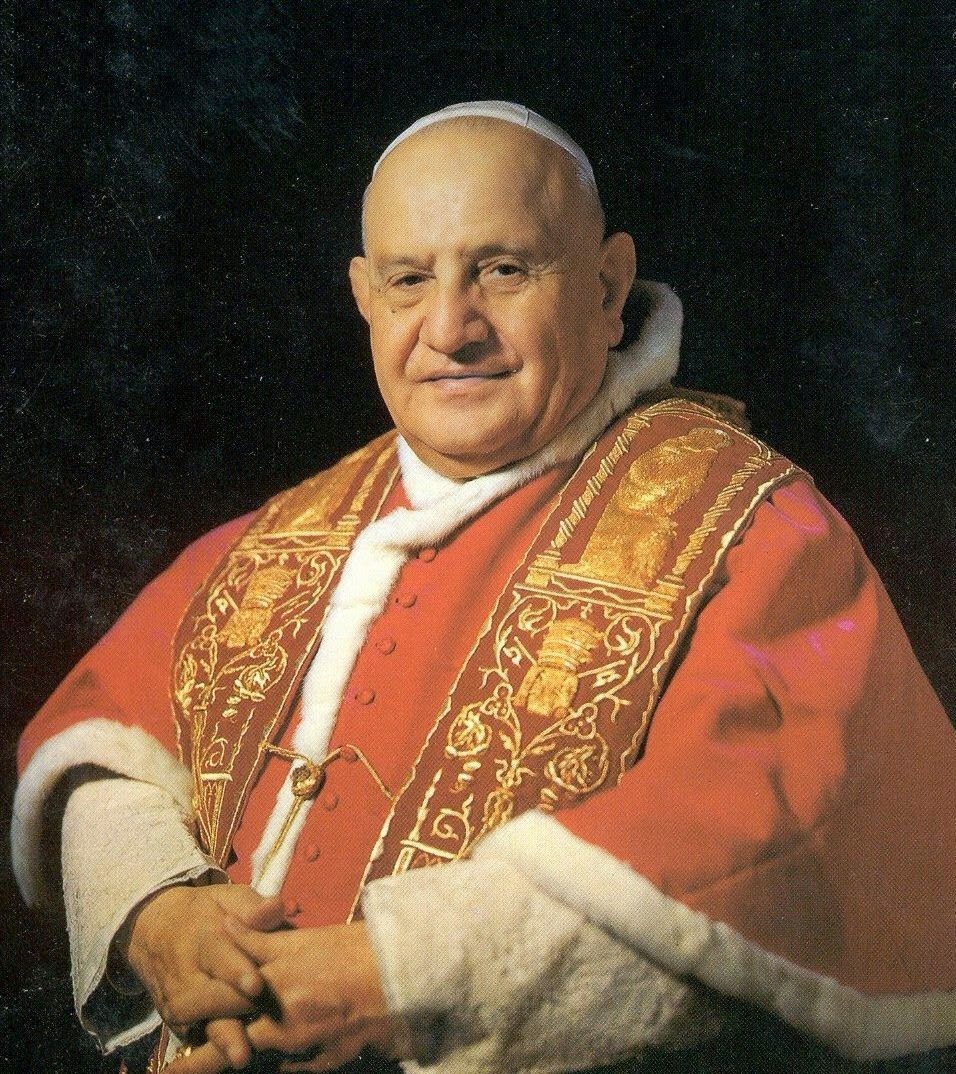
St. Pope John XXIII

PASTOR WITH A GREAT SENSE OF HUMOR! HE WAS NOT AFRAID TO LISTEN TO THE WORLD AND DARED TO OPEN THE WINDOWS AND DOORS OF THE CHURCH AND WELCOME THE WORLD IN ALL ITS GLORY AND WEAKNESS...

Short Reflection for the 2nd Sunday of Easter (A)

Dhikr for the 2nd Sunday of Easter (A): “We have seen the Lord…”

Readings: Acts 2: 42-47; 1 Peter 1: 3-9; John 20: 19-31

Text: Thomas, called Didymus, one of the Twelve, was not with them when Jesus came. So the other disciples said to him, "We have seen the Lord." But he said to them, "Unless I see the mark of the nails in his hands and put my finger into the nail marks and put my hand into his side, I will not believe." (John 20: 24-25)

Meditation: In life, we behave like Thomas. We do not believe unless we, too, put our fingers into the nail marks in Jesus’ body. Yet our faith lies NOT in seeing but on the testimony of believers… We accept the testimony, because we recognize the trustworthiness and integrity of the witnesses… Today, we are the witnesses of Jesus’ resurrection! Are we trustworthy witnesses…? (Bapa Jun)

DHIKR SIMPLE METHOD

1st step: Write the text or Dhikr (the Arabic word for REMEMBRANCE) in your heart.
2nd step: Let the text remain always in on your lips and mind - RECITING the text silently as often as possible...
3rd step: Be attentive to the disclosure of the meaning/s of the text in your life.

Saturday, April 19, 2014

The Bishop of Nuba Mountains and his Easter Message

An Easter Message from Bishop Andudu - Nuba mountains

John Chapter 20

The disciples, where threatened by the arrest and the death of Jesus,
they were so afraid and locked themselves in a room in great fear and
hopelessness. They thought that this was going to be the end of their
faith and the faith of Christians. The women were crying, they could
not save Jesus from the hands of the people who had arrested Him,
their teacher was killed, they witnessed everything, he died on the
cross between two criminals (the bad people the thieves) yet he did
not do anything to justify his death or deserve the death he received.
But it was all about you and me to be forgiven and saved.

His death was known to the people in the city, it was the bad news of
the week, the one who heals, feeds and teaches the people, the one who
confronts the evil and the leaders of the community with the truth was
killed. Evil seems like it is too strong in that week, death was
victorious, and it is the most feared enemy of the human being until
it was refitted.

Many of people including disciples and women thought it was over they
should find a way of going back to fishing or find any other work, and
it would have been the end of the Christian faith.

In the time of fear, frustration and hopelessness of Jesus followers
good news was brought by a woman that Jesus was resurrected and is
alive. The disciples rushed to the Tomb, it was true the tomb that was
empty up to today with Jesus resurrected, once and for all.

The resurrection message brought hope, strength and encouragement to
the followers of Jesus and entire Christian nations.

I know that we in the Nuba Mountains and other places in Sudan and
South Sudan, are in that bad week similar to the one that the
disciples and followers of Jesus had, of frustration, fear and
hopelessness.

In our region a meal for a child or elderly person is a challenge, we
live in fear, we don’t know what we are going to eat or give our
children in the following day. We don’t know that we are going to be
alive in the next day, who is going to die next and how? by a bullet
or Air bombardment, or Malaria. Who is going to save me on the next
day, where will I sleep tonight after my house is burned or destroyed?
How will I  protect myself from scorpions, snakes or mosquitoes in the
dark of the Cave in the mountains where most of Nuba currently live?

Those are the frustrations and hopelessness of the bad week, this bad
situation is real but Jesus also is real. Brothers and sisters in the
Nuba Mountains and elsewhere, may the good news of resurrection bring
you hope, encouragement and healing. May the resurrected Lord be real
to you, may He be present to each and every one of you.

The bible tells us that the disciples where together with doors locked
for fear, Jesus came and stood among them and said “ peace be with
you” I believe when he said that all fear, sadness and confusion was
replaced by courage, hope, peace and life. We need the same words of
Jesus “Peace be with you” in our various situations, families, cities,
countries and indeed we will have the peace that the world can not
understand, the peace that is not with standards of the world, but the
peace of God that passes all understanding. It will change a lot of
things and will change many people, this is the peace we need in Sudan
and South Sudan. May he bring us peace.

Before his death Jesus forgave those who arrested and planned to kill
him, after His resurrection he did not even attempt revenge, instead
he carried on with message of peace, the only way to prosper and have
peace, is the way of no revenge. Instead show forgiveness and love our
neighbours this is what Sudan and South Sudan needs.

Jesus was able to defeat evil, death, hatred, love of power & wealth
and all forms of corruption. He is alive and can do the same in your
life if you call on him with a sincere heart.  He is the savior, the
resurrection and the life.

Followers of Christ where ever you are can you ask in prayer the
resurrected Lord to be present and real to people who are in need.

I stand here in the hope of resurrection to ask you to speak more to
the world on behalf of those who are weak or helpless and give a
helping hand to the needy where ever they are because that is the part
of the resurrection hope.

May the risen Lord bring you light and hope.

Happy Easter to you all   - With prayers

Rt. Rev. Andudu Adam Elnail

Bishop of the [ECSSS] Diocese of Kadugli.