South Sudan's Challenge

South Sudan's Challenge
Healing & Reconciliation

Wednesday, May 22, 2019

Who Ow..?ns the Shari'a

Who Owns Islamic Law?
By DAVID GLENN

Some liberal scholars want to open the explication of sacred texts to all. Others say the path to democracy lies elsewhere.
If all goes according to plan, Iraqi political leaders will gather this year to forge a new national constitution. It is easy to imagine many things that might shipwreck the process. Near the top of that list: Will Iraq's political forces manage to find a consensus about what role, exactly, Islam should play in the public sphere?
That question has created deep tensions within Islamic reform movements for more than a century. Certain persistent strains of Muslim thought insist that an authentically Islamic nation must enforce Shariah -- traditional religious law --in all spheres of life, from banking to inheritance to the performing arts. Muhammad Kamaruzzaman, the assistant secretary general of an Islamist party in Bangladesh, recently wrote an essay celebrating democracy, but adding that "Islam does not accept the idea of separation of state from religion." Other Muslim activists, citing the recent unhappy history of Afghanistan and Iran, insist that lines must be drawn between mosque and state -- even if those lines do not look exactly like Western secular pluralism.
For outsiders, it is tempting to caricature this debate as a contest between Taliban-style radicals and Western-style liberals. (And there are indeed authentic  representatives of both those camps in Iraq today.) But the terrain is actually far more complex than that. There are dozens of strains of traditionalist and liberal thought in the Muslim world, each looking toward different conceptions of Shariah and drawing on different elements of Islamic history and jurisprudence.
Now a few prominent liberal scholars are aggressively promoting a concept that they believe can nurture democracy and allow an authentic Islam to thrive in the modern world. Islam can regenerate itself, these scholars say, if it returns to the principle of ijtihad.
The Arabic term -- which literally means "strenuous effort" -- has historically referred to the practice of systematically interpreting Islamic religious texts in order to resolve difficult points of law. (In an oft-cited example, early Muslim jurists strove to interpret an ambiguously phrased Koranic verse about how long a divorced woman must wait before remarrying.) In the early centuries of Islam, ijtihad was confined to an elite set of scholars and jurists (mujtahidin) with rigorous training in the religion's texts and laws. Beginning around the 12th century, most Muslim communities restricted the practice even further: Some juridical schools declared outright that "the gates of ijtihad have been closed," while other regions limited the practice of ijtihad to questions of the family and everyday life.
Today's proponents of ijtihad take a far more expansive view. "There will be no Islamic democracy unless jurists permit the democratization of interpretation," wrote M.A. Muqtedar Khan, a professor of political science at Adrian College, in a 2003 essay. In Mr. Khan's view, political elites in the Muslim world have for centuries restricted the development of democracy and political accountability by hiding behind religious principles that they proclaim to be fixed in stone. Mr. Khan argues, in effect, for an end run around the entire traditional apparatus of Muslim jurisprudence. Believers should instead, he suggests, look directly to the Koran and to the practices of Muhammad and his companions, and use their own efforts at interpretation to build ethical communities.
Mr. Khan is not alone in this general approach. He and four other scholars gathered at a 2004 conference on ijtihad, sponsored by the United States Institute of Peace. "Is ijtihad part of the expanding democratic culture of the Muslim world?" asks Muneer Fareed, an associate professor of Islamic studies at Wayne State University, who also spoke at the conference. "Or will it remain the forte of an exclusive group of intellectuals? These are some of the fundamental questions that people are asking today."
But other prominent scholars -- including some who share Mr. Khan and Mr. Fareed's urgent interest in pluralism and democracy -- have deep doubts about the ongoing conversations about ijtihad. Certain formulations of the ijtihad model, these skeptics say, are ahistorical and counterproductive. "Part of what hobbles their argument is that they're non-jurists," says R. Michael Feener, an assistant professor of religious studies at the University of California at Riverside. "They're non-law people talking about law."
Instead, Mr. Feener suggests that Muslim reformers should embrace, not discard, the heritage of Islam's traditional schools of jurisprudence. Other skeptics point to a striking irony: The ultra-traditional Salafist movements associated with Al Qaeda -- who are in some sense the polar opposite of the liberal enthusiasts of ijtihad -- use very similar language about scrapping the vast corpus of Islamic legal commentaries and returning to the original texts
Worlds Away From Wittenberg
The reformist interest in ijtihad is not new. For more than a century, Muslim scholars and activists have cited the concept as they have tried to respond to the trauma of colonialism and its aftermath. In his 1934 book The Reconstruction of Religious Thought in Islam, Muhammad Iqbal, the poet known as the spiritual father of Pakistan, argued for transferring "the power of ijtihad from individual representatives of [legal] schools to a Muslim legislative assembly," which would build toward "spiritual democracy which is the ultimate aim of Islam."
The latest proponents celebrate a much more inclusive model of ijtihad. No jurist can single-handedly interpret Islam, Mr. Khan says. "My argument is that Shariah should be by shura," or consultation, he says. "We should all consult among ourselves and conclude what God is telling us. ... Interpretation of God's message is the quintessential quality of humanity. To take away from me my right to interpret Islam, you have to deprive me of my humanity."
Even non-Muslims, Mr. Kahn says, should be permitted to participate in the process of ijtihad. "Islam belongs to all of us," he says. "It's not that Muslims own Islam, or that Muslim men own Islam, or that Muslim jurists own Islam."
Mr. Fareed cautions against making any glib historical analogies between ijtihad and Protestantism. "It certainly doesn't help to look for a Luther in Islam," he says. While Christian debates have historically centered on questions of doctrine and faith, he points out, Islam (like Judaism) tends to be consumed with debates about practice and ritual.
Among Muslim immigrants in the West, Mr. Fareed continues, debates about everyday practice -- such as whether it is permissible to pay interest -- have become very open and wide-ranging, thanks in part to the Internet. And as Western Muslims use ijtihad to debate such relatively quotidian questions, he says, they are also moving toward consideration of more fundamental questions about political structures and economic justice. Mr. Fareed hopes that these Western debates, couched within an Islamic vocabulary, will eventually provoke new kinds of conversations about democracy and political legitimacy in the heart of the Muslim world. (Last April Mr. Khan attended a scholarly conference in Saudi Arabia; when he returned, he wrote that he was, for the first time, cautiously optimistic that Saudi society was opening itself to "self-critical and reflective voices.")
Not all Muslim liberals, however, find the ijtihad model attractive. A very different strategy for working toward democracy and pluralism is put forward by Khaled Abou El Fadl, a professor of law at the University of California at Los Angeles. In Mr. Abou El Fadl's view, liberal Muslim scholars should revive, not dismiss, some of the longstanding threads of Islamic jurisprudence, looking carefully at historical cases in which Muslims have successfully built pluralist and relatively democratic societies.
Although Mr. Abou El Fadl's methodology is more elitist than Mr. Khan's vision of ijtihad for all, he also maintains that it will ultimately be more liberal. He wrote in a 2003 essay that basing government around consultation and shura, as Mr. Khan and his allies suggest, could lead to majoritarian tyranny. "Even if shura is transformed into an instrument of participatory representation," he wrote, "it must itself be limited by a scheme of private and individual rights that serve an overriding moral goal such as justice."
Mr. Abou El Fadl adds in an interview that he finds Mr. Khan's framework extremely ill-disciplined. "Instead of making the effort to study Arabic and study the texts," he says, "Muqtedar Khan is simply throwing around terms like ijtihad and mufti and fatwa. This kind of thing is why there's such a vacuum of authority. This is why we have people like bin Laden going around claiming to be Islamic."
If, as Mr. Khan suggests, ijtihad is truly open to all -- even to non-Muslims -- then what criteria, Mr. Abou El Fadl asks, can be used to distinguish sound doctrine? "If everyone's ijtihad is as good as anyone else's," he says, "then bin Laden's ijtihad is as good as Muqtedar Khan's."
"In its pristine form, shura was consultation on a patriarchal or tribal basis," says Emran Qureshi, a fellow at Harvard University's Carr Center for Human Rights Policy, who is sympathetic to Mr. Abou El Fadl's position. "It's difficult to tie a notion of modern democratic practice to that notion."
Mr. Khan, for his part, finds this position impossibly elitist. In a 2004 article, he charged that Mr. Abou El Fadl's model of liberal jurisprudence "allows the intellectual colonialism of Islamic legalism -- its tendency to engulf and marginalize other fields of study -- to subvert his quest for an Islamic democracy."
A middle ground of sorts is offered by Ingrid Mattson, a professor of Islamic studies at the Hartford Seminary. Ms. Mattson argues that there should be a wide scope for popular ijtihad, but adds that the process should be watched over by well-trained Islamic legal scholars. "The proper role of scholars and religious and legal specialists," she says, "is simply to point out when certain boundaries are being crossed. Not to dictate the process of ijtihad, but to monitor it in a way that is helpful and supportive of the development of society.
Political Convergence
All parties in this debate over ijtihad emphasize that their ultimate political visions are similar: They would like to see majority-Muslim countries develop democratic and accountable institutions, and to combine authentically Muslim cultural values with ample protection for individual rights and religious minorities.
Yet the devil emerges in the details. If even scholars with such harmonious visions find themselves tangled in argument, how much more difficult will it be for Iraqi political leaders trying to forge a new constitution?
Part of the difficulty, says Mr. Qureshi, is that "secularism" has been so thoroughly discredited in the Muslim world by Kemal Atatürk's ruthlessly anti-clerical regime in Turkey and by the later secular-authoritarian governments in Algeria, Egypt, Syria, and Iraq. Only in Iran, which has suffered under a clerical tyranny for decades, do reformers now commonly talk about secular pluralism.
The fundamental challenge for would-be democracy-builders in Iraq and elsewhere is the contested relationship between Islam and the public sphere, Ms. Mattson says. Where religious authorities and institutions once had breathing room from the state and their own spheres of influence, she says, colonial regimes brought everything under the heel of the government. (And their postcolonial successors have been happy to do likewise.)
The opposite dilemma sometimes arose in the early centuries of Islam, Ms. Mattson suggests. In certain communities at that time, she says, Muslim jurists were in a sense too detached from the state. They protected their independent spheres by "trying to stay out, to some extent, of what they considered to be the proper jurisdiction of the government or the ruler. And they also really did believe that politics was corrupting. 
So the jurists were sometimes very good at looking at the rights of individual slaves, yet they never really addressed the issue of the slave trade and its overall political and economic considerations."
This, then, is the dilemma for reformers today. Centrist Islamists and liberal reformers would like to develop a model in which Muslim institutions are independent from the government and vigorously inform public governance, but do not swallow all of society in a totalitarian project like the Taliban's.
"A postcolonial context requires new institutions," says Mr. Fareed, of Wayne State. "So a debate has been stirred. Will we simply remake classical institutions, or will we take into consideration the changes that modernity and colonialism have wrought on Muslim society, and engage in a new form of ijtihad to establish new institutions based on these changes?"
Eastern Winds
Mr. Feener, of Riverside, believes that there are exciting and productive debates occurring along just those lines -- but they aren't happening in the Westernized context that is touted by the ijtihad enthusiasts. Instead, he says, the most intellectually exciting place in the Muslim world today is Indonesia, where students are reading translations of "works translated from Egyptian and Moroccan thinkers. You find works from Iranian thinkers. You find translations of people working in the States, like Khaled Abou El Fadl. I would argue that Indonesians are discussing these writers more than anyone else in the Muslim world. 
They're also reading Frankfurt School types, like Habermas. People know them. People know these debates about civil society."
In Mr. Feener's eyes, however, there are important differences between these rich Indonesian debates and the ijtihad model put forward by Mr. Khan and his allies. In Indonesia, he says, "the basic approach that many of these folks take to Islamic law is by diving very, very deep into the historical tradition of Muslim interpretations. That is, they look at the debates that scholars have held among themselves over the last 1,200 years. The idea is to find places within the tradition -- variant opinions within the tradition -- that can be further developed, because their day has come. Islamic literature preserves this diversity of tradition."
The push toward ijtihad, by contrast, neglects the richness of Islamic legal history, in Mr. Feener's view. "This has been signaled by many in Indonesia as a kind of arrogance," he says. "The notion that you can see clearly the will of God in the seventh century in a way that all of these distinguished jurists who came before you couldn't imagining that you and you alone can see what was going on in the time of the Prophet has historically lent itself to a kind of authoritarianism in Islamic speech."
Mr. Khan, meanwhile, insists that the most urgent danger of authoritarianism lies in entrusting Islamic thought and interpretation to an elite corps of scholars and jurists. "There are some serious issues that Muslims have to deal with," he says. "One of them is that they have to reach a conclusion that shura is binding. Right now many scholars say, 'You have to consult,' but they don't really mean it. Shura has to be binding, otherwise the governance is not legitimately Islamic."
Mr. Khan acknowledges that his is very much a minority view. He is nonetheless excited about the current intellectual climate. "Two weeks ago I was at the Stanley Foundation and one-third of my audience was Muslims," he says. "Afterward we spent the whole night having a Muslim-Muslim dialogue. We disagreed about everything. But we did come to consensus on one point -- and that is that the discussions are getting more sophisticated. There is no doubt about it."

Tuesday, May 21, 2019

6th Sunday of Easter (C)


Short Reflection for the 6th Easter Sunday (C)

Readings: Acts 15: 1-2. 22-29; Revelation 21: 10-14. 22-23; John 14: 23-29
Selected Passage:  Peace I leave with you; my peace I give to you. Not as the world gives do I give it to you. Do not let your hearts be troubled or afraid. (John 14: 27)

 Reflection:  There are many things that bother us and cause us so many anxieties. The Gospel tells us ‘do not let our hearts be troubled or afraid’.  The Risen Christ remains with us.  And every time we gather in his name and remember his words and deeds, especially at the breaking of the bread, there he dwells.  We need to hear again his assurance” “do not ket your hearts be troubled...” The Risen Lord gives us PEACE!  www.badaliyya.blogspot.com

DHIKR PRAYER SIMPLE METHOD...

Dhikr is an Arabic word for remembrance. In the “tariqa” (the way) movement, Dhikr developed into a form of prayer… It is a prayer of the heart… following three simple steps:

1.Write in one’s heart a certain passage of the Holy Writ…
2.Make the same passage ever present in one’s lips. 
3.Then wait for God’s disclosure on the meaning of the passage…that interprets one’s life NOW…!

It takes a week of remembering (dhikr)…or even more days to relish the beauty of this method…

Monday, May 13, 2019

5th Sunday of Easter (C)


Short Reflection for the 5th Easter Sunday (C)

Readings: Acts 14: 21-27; Revelation 21: 1-5; John 13: 31-33. 34-35

Selected Passage:  “I give you a new commandment: * love one another as I have loved you, so you also should love one another.  This is how all will know that you are my disciples, if you have love for one another." (John 13: 34-35)

 Reflection:  The new measure of our love for on another is the love of Christ for each one of us.  Jesus shows his love in the CROSS, that is, Jesus’ self-expenditure that we may have life to the full.  ‘Love one another as I have loved you’. By this kind of love, people will know that we bear the name Christians are his true disciples! www.badaliyya.blogspot.com

DHIKR PRAYER SIMPLE METHOD...
Dhikr is an Arabic word for remembrance. In the “tariqa” (the way) movement, Dhikr developed into a form of prayer… It is a prayer of the heart… following three simple steps:

1.Write in one’s heart a certain passage of the Holy Writ…
2.Make the same passage ever present in one’s lips. 
3.Then wait for God’s disclosure on the meaning of the passage…that interprets one’s life NOW…!

It takes a week of remembering (dhikr)…or even more days to relish the beauty of this method…

Wednesday, May 8, 2019

Waiting for the Resurrection

WAITING FOR THE RESURRECTION

If there's an all-knowing, all-powerful, and all-loving God who is Lord of this universe, that presence isn't very evident on the evening news.

It's fair and reflective to wonder: Where is the resurrection in all of this? Why is God seemingly so inactive? Where is the vindication of Easter Sunday?

God, as revealed in the death and resurrection of Jesus, doesn't meet our expectations even as he infinitely exceeds them. What the resurrection teaches is that God doesn't forcibly intervene to stop pain and death. Instead he redeems the pain and vindicates the death.

Good and truth will always triumph, but this triumph must be waited for, not because God wants us to endure pain as some kind of test, but because God, unlike ourselves, doesn't use coercion or violence to achieve an aim. God uses only love, truth, beauty, and goodness and God uses these by, structurally and non-negotiably, embedding them into the universe itself, like a giant moral immune-system that eventually, always, brings the body back to health.

God doesn't need to intervene like a super-hero at the end of a Hollywood movie and use a morally- superior violence to kill the bad people so that the good are spared pain and death. God lets the universe right itself the way a body does when it is attacked by a virus. The immune-system eventually does its work, even if, in the short term, there are pain and death. But always, in the end, the universe rights itself.

Simply put: Whenever we do anything wrong, anything at all, it won't turn out right. It can't. The structure of the universe won't receive it and it comes back to us, one way or the other. Conversely, whenever we do something right, anything that's true, good, loving, or beautiful, the universe vindicates that. It judges our every act and its judgement allows no exceptions.

Perhaps that judgement doesn't seem to be immediate, it can seem a long time in coming and thus, for a time, we can be confused and ask the question: "Why doesn't God, truth and goodness, come down off the cross?" But, eventually, without a single exception, evil is shamed and good triumphs. The resurrection works.

To read more click here or copy this address into your browser http://ronrolheiser.com/waiting-for-the-resurrection/#.XLTHBKZ7k_8
www.facebook.com/ronrolheiser

Monday, May 6, 2019

4th Sunday of Easter (C)

Short Reflection for the 4th Easter Sunday (C)

Readings: Acts 13: 14. 43-52; Revelation 7: 14b – 17; John 10: 27-30

Selected Passage:  “My sheep hear my voice; I know them, and they follow me. I give them eternal life, and they shall never perish.” (John 10: 27-28)

Reflection:  The newness of Christianity is the FAMILIARITY and the FRIENDSHIP we have established with God through Jesus Christ. Through him, with him and in him, we hear his voice, recognize and know God. God knows each one of us and He calls each one by name. And he gives us eternal life. www.badaliyya.blogspot.com

DHIKR PRAYER SIMPLE METHOD...
Dhikr is an Arabic word for remembrance. In the “tariqa” (the way) movement, Dhikr developed into a form of prayer… It is a prayer of the heart… following three simple steps:

1.Write in one’s heart a certain passage of the Holy Writ…
2.Make the same passage ever present in one’s lips. 
3.Then wait for God’s disclosure on the meaning of the passage…that interprets one’s life NOW…!

It takes a week of remembering (dhikr)…or even more days to relish the beauty of this method…

Tuesday, April 30, 2019

Fatherless at the Depths of our Beings

FATHERLESS AT THE DEPTHS OF OUR BEING

A father had two sons. The younger comes to him and says: ‘Father give me the share of the property that’s coming to me.’ His father shares out his goods. The younger son takes his share, leaves for a distant country, and squanders his property on a life of debauchery. When he has spent everything, he finds himself hungry and humiliated and sets off to return to his father’s house, where he is undeservedly greeted, embraced, and taken back by his father.

At one level, the lesson is clear: God’s mercy is so wide and compassionate that nothing we can do will ever stop God from loving us.

But (philosopher and theologian) Jean-Luc Marion, drawing upon the specific wording of the Greek text, emphasizes another element in this story.  It implies that the son went to his father and asked for something more than property and money. It says that he asked his father for his share of the property (ousia).  Ousia, in Greek, means “substance”. He’s asking for his life, as independent of his father.

As a son and an heir, he already has use of his share of what is rightfully his; but he wants to own it and not owe it to anyone. He wants to have it as independent of his father, as cut off from his father,  in a way that he no longer has to acknowledge his father in the way he receives his life and freedom and uses them. The consequence of that, as this parable makes clear, is that a gift no longer sensed or acknowledged as gift always leads to the misuse of that gift, to the loss of integrity, and to personal humiliation.

The prodigal son wanted his life and the freedom to enjoy life completely on his own terms and, for him, that meant he had to take them outside his father’s house. That’s why Jesus repeated again and again, that he could do nothing on his own. Everything he was and everything he did came from his Father.

Our lives are not our own. Our lives are a gift and always need to be received as gift. We can enter our lives and freedom and enjoy them and their pleasures, but as soon as we cut them off from their source, take them as our own and head off on our own, dissipation, hunger, and humiliation will follow.

Tuesday, April 23, 2019

2nd Sunday of Easter (C)


Short Reflection for the 2nd Easter Sunday (C): DIVINE MERCY SUNDAY

Readings: Acts of the Apostles 5: 12-16; Revelation 1: 9-11a, 112-13, 17-19; John 20: 19-31

Selected Passage:  Jesus said to him (Thomas), "Have you come to believe because you have seen me? Blessed are those who have not seen and have believed." (John 20:29)

Reflection:  Do we need to put our fingers into his wounds in order to believe…?  Jesus is, truly, RISEN!  We believe, because the testimonies of his disciples are trustworthy. They saw and experienced the Risen Lord.

Today we remember God’s Divine Mercy. In the passion, death and resurrection of the Lord, we experience God’s unfathomable Divine Mercy.

DHIKR PRAYER SIMPLE METHOD...

Dhikr is an Arabic word for remembrance. In the “tariqa” (the way) movement, Dhikr developed into a form of prayer… It is a prayer of the heart… following three simple steps:

1.Write in one’s heart a certain passage of the Holy Writ…
2.Make the same passage ever present in one’s lips. 
3.Then wait for God’s disclosure on the meaning of the passage…that interprets one’s life NOW…!

It takes a week of remembering (dhikr)…or even more days to relish the beauty of this method…

Wednesday, April 17, 2019

On Joy and Pain in Life

ONE OF ISAIAH’S VISIONS

These are important questions because how we understand the relationship between joy and pain helps determine how we understand ourselves, happiness, and the gospel.

Too often we have the false idea, very prevalent in our culture, that joy and pain are incompatible, and that Christ came to rescue us from pain. Our culture tends to believe that if you are in pain you cannot be happy and to be happy you must avoid pain.

Nothing could be further from the truth. Joy and pain are not incompatible, and Christ does not, as poor preaching sometimes wants us to believe, promise us less pain. The reverse is closer to the truth, though any formula linking joy and pain must be very carefully worded since masochism is always a danger.

Careful wording aside, in this life, joy always comes with pain. Joy and pain both lie at the heart of what it means to be human. In terms of a biblical definition, the human being might well be defined as a being of joy, living in pain. And in the end that is what separates us from the rest of creation.

The paradoxical connection between joy and pain, ultimately, points us towards eternity. By revealing to us our limits, it points us towards something greater, God's kingdom, a higher synthesis of love and communion, within which, as the vision of Isaiah has it, there will be satisfaction without limit, embrace without distance, success without jealousy, smiles without tears, reunions without separation, joys without missing your loved ones, and life without death.

What Christ promises us is not a life on this earth without pain, but an eventual joy that will be clear-cut, pure, and which no one or no thing can ever take from us.


Thursday, April 11, 2019

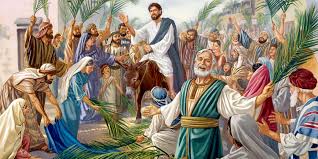
Palm Sunday (C)


Short Reflection for Palm Sunday (C):The Lord’s Passion

Readings: Isaiah 50: 4 – 7; Philippians 2: 6 – 11; Luke 22: 14 – 23: 56

Selected Passage: Then he said, "Jesus, remember me when you come into your kingdom." He replied to him, "Amen, I say to you, today you will be with me in Paradise." (Luke 23: 42-43)

Reflection: The Palm of Triumph

The peaceful figure of Jesus rises above the hostility and anger of the crowds and the legal process. Jesus remains a true model of reconciliation, forgiveness and peace. In the midst of his own agony and trial, we realize the depths of Jesus' passion for unity. He is capable of uniting even Pilate and Herod together in friendship (23:12). From the cross, Luke presents Jesus forgiving his persecutors (23:34) and the dying Jesus allows even a thief to steal paradise! (23:43).

In reading the Passion of the Lord (Luke’s version), we meditate on God’s mercy, forgiveness and reconciling power. In Jesus’ passion, death and resurrection, we have been reconciled with God and with one another. www.badaliyya.blogspot.com

DHIKR PRAYER SIMPLE METHOD...
Dhikr is an Arabic word for remembrance. In the “tariqa” (the way) movement, Dhikr developed into a form of prayer… It is a prayer of the heart… following three simple steps:

1. Write in one’s heart a certain passage of the Holy Writ…
2. Make the same passage ever present in one’s lips.
3. Then wait for God’s disclosure on the meaning of the passage…that interprets one’s life NOW…!

It takes a week of remembering (dhikr)…or even more days to relish the beauty of this method…


Wednesday, April 10, 2019

Passion Sunday (C)


Short Reflection for Palm Sunday (C):The Lord’s  Passion

Readings: Isaiah 50: 4 – 7; Philippians 2: 6 – 11;  Luke 22: 14 – 23: 56

Selected Passage:  Then he said, "Jesus, remember me when you come into your kingdom." He replied to him, "Amen, I say to you, today you will be with me in Paradise." (Luke 23: 42-43)

Reflection:  The Palm of Triumph

The peaceful figure of Jesus rises above the hostility and anger of the crowds and the legal process. Jesus remains a true model of reconciliation, forgiveness and peace. In the midst of his own agony and trial, we realize the depths of Jesus' passion for unity. He is capable of uniting even Pilate and Herod together in friendship (23:12). From the cross, Luke presents Jesus forgiving his persecutors (23:34) and the dying Jesus allows even a thief to steal paradise! (23:43).

In reading the Passion of the Lord (Luke’s version), we meditate on God’s mercy, forgiveness and reconciling power.  In Jesus’ passion, death and resurrection, we have been reconciled with God and with one another. www.badaliyya.blogspot.com

DHIKR PRAYER SIMPLE METHOD...

Dhikr is an Arabic word for remembrance. In the “tariqa” (the way) movement, Dhikr developed into a form of prayer… It is a prayer of the heart… following three simple steps:

1.Write in one’s heart a certain passage of the Holy Writ…
2.Make the same passage ever present in one’s lips. 
3.Then wait for God’s disclosure on the meaning of the passage…that interprets one’s life NOW…!

It takes a week of remembering (dhikr)…or even more days to relish the beauty of this method…


Monday, April 8, 2019

The Power of Helplessness

THE POWER OF HELPLESSNESS

When we speak of "the passion of Jesus Christ" we are not talking so much about anything that Jesus actively did, but rather about what was done to him, what he endured, what he submitted to and what he carried in silence during his last hours on earth.

But what is the value of such "passivity"? How does silent suffering, that does not actively intervene and alter a situation, change anything? Why do we value Jesus' passion so much when it was precisely the time in his life and ministry (a very short time in fact) when he was not preaching, teaching, feeding, healing, and actively helping others? How can one help anyone by standing helplessly by as injustice unfolds? What is the value of these things: Sweating blood in a garden? Silent tears? Prayers that aren't publicly manifest? Interior dissent that is powerless to change the actual situation on the outside?

Jesus answered this with another question: "Wasn't it necessary?" Doesn't defeat sometimes mean victory? Aren't silent suffering, interior protest, and helpless empathy sometimes the real weapons for change? Isn't the sweating of blood the key to sustaining all of our commitments? Isn't the carrying of tension the key to love and family life? Isn't it only when we admit our helplessness that God finally enters? 

"Why is this necessary"? The answer to that questions lies at the heart of all wisdom, all Christian revelation, all depth, all maturity. But it is an answer that we will not find in books, nor in Socratic reflection. We will find it precisely when we ponder in the biblical sense, namely, when we stand helpless, muted, and frustrated, but listening, before a pain, an illness, or an injustice that so overwhelms us that we are unable to rely on any power save that of God.
What is taught us there holds the key to everything.


Tuesday, April 2, 2019

Shedding Things...

SHEDDING THINGS

From a certain point onward in our lives we begin to accumulate things, often without really realizing it.
Like the rooms in our houses, every day that we live, our internal rooms also fill up with more and more stuff: valuable things, toxic things, and junk. We all carry a lot more baggage now than we did at seventeen and this makes travel difficult, especially the travel that is asked of us as we get older, namely, the journey to become a gracious older woman or man, an adult, an elder, one who has aged gracefully, can bless the young, and let go of life without anger or silly clinging so as not to end up an embittered, old fool, but a happy, holy fool.
Julian of Norwich states that we will cling to God only when we no longer cling to everything else. Richard Rohr agrees with that, but expresses it this way:  As we get older, he submits, the real task of life, both in terms of human growth and life in God, is to begin to shed things, to carry less and less baggage, to slim-down spiritually and psychologically to match the meagerness of  the  possessions we  had  when we  were seventeen years  old and could still put  all we own  into  one little suitcase.
"Naked I came from my mother's womb and naked I go back again. The Lord gives and the Lord takes. Blessed be the name of the Lord." 
Adulthood is contingent upon appropriating that.

5th Sunday of Lent (C)

Short Reflection for the 5th Sunday in Lent (C)

Readings: Isaiah 43: 16 – 21; Philippians 3: 8 – 14; John 8: 1 – 11

Selected Passage:  “Then Jesus straightened up and said to her, ‘Woman, where are they?  Has no one condemned you?’  She replied, ‘No one, sir.’  Then Jesus said, ‘Neither do I condemn you. Go, (and) from now on do not sin any more.’” (Luke 8: 10-11)

Reflection:  The gospel tells us that God does not condemn us.  In fact, he gives us the grace not only to free us from our past but the opportunity to begin anew. Such is the LOVE of God that he offered his only begotten Son that we may have new LIFE!  Jesus tells us be slow in our judgment of others, because we ourselves are  sinners.  The Season of Lent is an invitation to be RICH in Mercy and Compassion. Cf. www.badaliyya.blogspot.com

DHIKR PRAYER SIMPLE METHOD...

Dhikr is an Arabic word for remembrance. In the “tariqa” (the way) movement, Dhikr developed into a form of prayer… It is a prayer of the heart… following three simple steps:

1.Write in one’s heart a certain passage of the Holy Writ…
2.Make the same passage ever present in one’s lips. 
3.Then wait for God’s disclosure on the meaning of the passage…that interprets one’s life NOW…!

It takes a week of remembering (dhikr)…or even more days to relish the beauty of this method…