South Sudan's Challenge

South Sudan's Challenge
Healing & Reconciliation

Friday, June 21, 2013

Dhikr for the 12th Sunday in Ordinary Time (C)


The Dhikr for 12th Sunday of the Ordinary Year (C)
Readings: Zechariah 12: 10-11; 13:1; Galatians 3: 26-29; Luke 9: 18-24
Text:  “Once when Jesus was praying in solitude, and the disciples were with him, he asked them, ‘Who do the crowds say that I am?’ They said in reply, ‘John the Baptist; others, Elijah; still others, One of the ancient prophets has arisen.’ Then he said to them, ‘But who do you say that I am?’ Peter said in reply, ‘The Messiah of God’.” (Luke 9: 18-20)
Reflection:  Today, each one us is being confronted to answer that specific question, “Who Jesus is in our lives…? There is NO more escaping… and our honest reply shapes our actual lives and our relations with our neighbors, especially the least…
DHIKR SIMPLE METHOD...
1st step: Write the Dhikr in your heart.
2nd step: Let the Dhikr remain always in on your lips and mind - RECITING the dihkr silently as often as possible...
3rd step:  Be attentive to the disclosure of the meaning/s of the Dhikr in your life.
Bapa Elisha

Saturday, June 15, 2013

11th Sunday in Ordinary Time (C)


The Dhikr for 11th Sunday of the Ordinary Year (C)
Readings: 2 Samuel 12: 7-10, 13; Galatians 2: 16, 19-21; Luke 7: 36 - 8: 3 
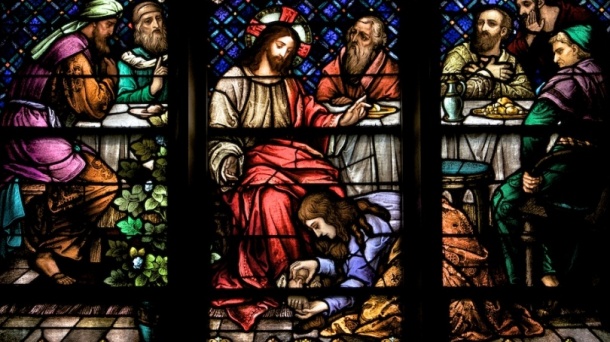
Selected Gospel Passage: Jesus turned to the woman and said to Simon, 'you see this woman? I came into your house, and you poured no water over my feet, but she has poured out her tears over my feet and wiped them away with her hair. You gave me no kiss, but she has been covering my feet with kisses ever since I came in. You did not anoint my head with oil, but she has anointed my feet with ointment.  For this reason I tell you that her sins, many as they are, have been forgiven her, because she has shown such great love. It is someone who is forgiven little who shows little love.' Luke 7: 44-47)
Reflection:  Today, each one us is being confronted by the woman in the Gospel… Her many sins are forgiven, because she has shown such great love!  Have we, too, shown such great love…? There is NO more escaping behind the ‘rug’ of rituals and formulas!
DHIKR SIMPLE METHOD...
1st step: Write the Dhikr in your heart.
2nd step: Let the Dhikr remain always in on your lips and mind - RECITING the dihkr silently as often as possible...
3rd step:  Be attentive to the disclosure of the meaning/s of the Dhikr in your life.
Bapa Elisha

A Long Journey towards Retrieving our Humanity...


Response to Prof. John Paul Lederach’s Paper
By Eliseo “Jun” Mercado, OMI

I would like to begin my remarks by citing the very well worded paper, “The Long Journey Back to Humanity” that provides, I believe, the correct locus for a theology of “Catholic” peacemaking. Yes, it is a journey back to humanity that is done in full cognizance of the nature and context of contemporary armed conflict and the unique location of the Catholic Church within that given context.

The four cited narratives – two in Colombia, one in Southern Philippines and one in Uganda speak for themselves. There are, however, common strands in these four stories that I wish to highlight as I re-affirm this journey. They are the following:

First is the dynamic nexus between word, context and action. I agree with Prof. Lederach in pointing out that “this is particularly true of areas of life and action in a context where details of belief and doctrine are not explicitly developed. A continuing journey captures not only the dynamic movement of the peacemaking but also the reality that peace making is a process. It is not the “Pax Romana” of old, nor is it the “mission civilisatrice” during the colonial times. Rather, peacemaking, especially in a protracted and identity conflicts, is a continuing process of “see, judge and act”. I believe that the theology of peacemaking, specifically amid armed conflict, will continue to be at the “edge”. Theologians of peacemaking need, however, to make sure that “doing theology at the edge” will be sharp enough to be able to “cut through” the mainstream sacramental and systematic theology that would keep them “uncomfortable”. After all, this precisely is the legacy and the dangerous memory that the prophetic ministry keeps alive in the church.

Second is the “historic” and “privileged” location of the Catholic Church in actual peacemaking on the ground. In all four narratives, the Catholic Church enjoys not only high social capital with high trust level to serve as a sort of “bridge” between and among diverse actors/protagonists in the conflicts but also, historically, is the alternative institution outside the state. John Paul Lederach expresses this in a fascinating phrase, “Ubiquitous Presence”. Yes, it is a sociological term yet theologically loaded that holds the church accountable and responsible. It is something akin to the parable of the Talents... “To whom more is given... more shall be accounted!” That ubiquitous presence serves as a critique and an imperative for the Church.

Moreover, the victims and the protagonists in the armed conflicts notwithstanding ideological or faith identities, rightly or wrongly, fall within the “service” or “ministry” that the Church claims. In many ways, this peace making ministry or service that claims a prophetic root is another “dangerous” strand that follows yet another beautiful and equally dangerous strand, the liberation theology, that is now a patrimony of the Catholic Church (for good or bad).

Third is the dialogical dimension of the journey. Here, I would simply reiterate what Bishop Serna and Archbishop Castro of Colombia have already articulated: “dialogue is (1) the most worthy human experience”. In fact, we are encouraged “to envision dialogue in the arrival of Jesus as the word made flesh and the only way that human community creates meaning both within and with God.” The “dialogos pastorales” developed in Colombia with armed actors do not only aim to humanize the conflict but also to re-build relationships that are more humane, just and equitable.

Ultimately, what does it mean to be human? How might we reclaim our humanity? Allow me to quote Pope Benedict XVI, who in his latest encyclical, “Spe Salvi”, has written: "the capacity to accept suffering for the sake of goodness, truth and justice is an essential criterion of humanity, because if my own well-being and safety are ultimately more important than truth and justice, then the power of the stronger prevails, then violence and untruth reign supreme. Truth and justice must stand above my comfort and physical well-being, or else my life becomes a lie. For this we need witnesses. We need them if we are to prefer goodness to comfort, even in the little choices we face each day. Our Holy Father concludes: "the capacity to suffer for the sake of the truth is the measure of humanity." Our peacemakers on the ground are, indeed, witnesses to that attempts to retrieve our common humanity amid the cruelties and destruction of war and armed conflicts.

The fourth is the ethical road map in peacemaking. The engagement is oriented to restoration/retrieval of humanity, community, family and individual lives. It is an ethical road map that challenges the prevailing violence, killings and other criminalities that often mar armed conflicts. This ethical road map is, as presented in the paper, rooted in our identity and dignity as children of God – the very prominent theme in Social teachings legacy albeit little known or “our best kept secret”.
When we speak of ethical road map it, basically, involves truth and morality. This leads us to the imperatives of witnessing to the truth. In his encyclical, “Pacem in Terris”, Pope John XXIII exhorts that it is the fundamental duty of the government to uphold the truth: "A political society is to be considered well-ordered, beneficial and in keeping with human dignity if it is grounded on truth." Moreover, the encyclical explains that unless a society is anchored on the truth, there can be no authentic justice, charity and freedom.

No, we cannot have peace based on aggression! No, we cannot have peace based on killing and crimes against humanity! Respect for life; Recognition of their human dignity as God’s sons and daughters; and holding their basic rights as inalienable are non- negotiable landmarks of an ethical road map in any peacemaking.

The fifth is the grounding of the journey in hope. I can identify with the “haiku” formulated by Sr. Mary:

“For all the children We smile amidst suffering To give them courage.” (2)

In many cases, where we feel our own powerlessness and vulnerability vis-Ă -vis the powers that be and the “mighty”, our presence, our tears and smile give courage amidst suffering that give the weak and poor that courage and hope to rise anew and face the new day.

But this path opens a new aspect... it requires not only a theology of peacemaking but also the spirituality of peacemakers. Since we have in the audience two religious traditions – the Dominicans and the Jesuits, I will cite the Dominican “contemplatio vertitatis” and the Ignatian “familiaritas cum Deo”. The contemplation of truth and the familiarity with God involve the illumination of the intellect, coming to know who God is and what God wills. They also involve the conversion of the heart and the reconfiguration of the same heart. Beholding God and becoming familiar with God entail transforming and conforming my thinking, my feeling and my doing in accordance to the Lord's, which can only be the work of grace.

Contemplation of God and Familiarity with God thus entail rejoicing in what God delights - the truth; abhorring what God detests - falsehood; being pained by what breaks the heart of God - the persecution of truth-seekers. Contemplation of God and Familiarity with God means sharing the passion of God for the truth and the pathos of God whenever the truth and the bearers of truth are overcome by the forces of the lie.

When everything is said and done... the theology and the spirituality of peacemakers is, precisely, the theology and the spirituality of martyrs... Last Holy week, my uncle, the doyen of Philippine journalism – Juan Mercado – wrote in one of his passionate columns in the Philippine Inquirer that the increasing number of people who have shed their blood and have died for peace and justice are the “Good Friday” people. Yes, they, like Jesus, willingly gave up their lives as a “ransom” that others may live and live to the full! More than ever... in a world broken and fractured by armed conflicts on the basis of poverty, ideologies, ethnicities, beliefs and races, we need “Good Friday” People!

Fr. Eliseo 'Jun' Mercado, OMI
April 13, 2008 
Catholic Peacebuilding Conference University of Notre Dame 
South bend, Indiana

Friday, June 14, 2013

Love and Forgiveness...


Love as Consequence of Authentic Forgiveness

June 10, 2013 by Fr. Thomas Rosica Leave a Comment
Share  
Jesus anointed by woman cropped
The Eleventh Sunday in Ordinary Time, Year C – June 16, 2013
Throughout the Gospels, Jesus dines with sinners and takes the opportunity to teach some very important lessons about discipleship and holiness.
As with so many things he did, Jesus’ befriending such types of people and eating with them angered his opponents, especially the religious leaders of his day. They murmured against him: “He has gone in to be a guest of a man who is a sinner,” or “Look at him who eats with tax-collectors and prostitutes!” But where others saw only sinners, people on the fringe, public pariahs to be hated and isolated, Jesus saw human beings cowering in the shadows, often trapped in their own failure, desperately trying to be something better, awkwardly trying to make amends for a life of injustice.
It was so often at meals that Jesus seemed to show most clearly that he reconciled sinners. How can we not recall the stories of Zacchaeus, Levi, the woman who washed Jesus’ feet with her tears, the disillusioned disciples at Emmaus, and Peter at the lakeside? Even the Last Supper, which we think of instinctively as a very sublime occasion, was a meal shared with sinners. Jesus’ table includes Judas (his betrayer), Peter (who denied him), and the squabbling and obtuse disciples. The early Church founded its understanding of the Eucharist on the basis of the dangerous memory of Jesus’ table fellowship.
The woman party crasher
In today’s Gospel story of the pardoning of the sinful woman (7:36-50), a Pharisee, suspecting Jesus to be a prophet, invites Jesus to a festive banquet in his house, but the Pharisee’s self-righteousness leads to little forgiveness by God and consequently little love shown toward Jesus. The sinful woman, on the other hand, manifests a faith in God that has led her to seek forgiveness for her sins, and because so much was forgiven, she now overwhelms Jesus with her display of love. The whole episode is a powerful lesson on the relation between forgiveness and love.
Why did this nameless woman approach Jesus and anoint him at the risk of ridicule and abuse by others? Her action was motivated by one thing: her love for Jesus and her gratitude for his forgiveness. She did something a Jewish woman would never do in public: She loosed her hair and anointed Jesus with her tears. She also did something that only love can do: She took the most precious thing she had and spent it all on Jesus. Her love was not calculated but lavish and extravagant.
Jesus recounts what he saw the woman do (vv 44-46). The purpose of this recitation is not so much to accuse Simon for what he did not do. Does Simon persist in seeing the woman as a sinner, or is he able to reinterpret her actions? If Simon is still not able to come up with a different evaluation of what he saw, Jesus tries to persuade Simon to see as he sees: She has been forgiven much and now shows great love (vv 47-48).
This woman is not forgiven because of her lavish demonstrations of love; rather, the loving actions follow from her experience of having been forgiven. Verse 47 sums it up beautifully: “Her many sins have been forgiven; hence, she has shown great love” (literally, “her many sins have been forgiven, seeing that she has loved much.”) Her love is the consequence of her forgiveness. This is also the meaning demanded by the parable in Luke 7:41-43.
Love covers a multitude of sins
Is our love extravagant or miserly? Jesus makes clear that great love springs from a heart forgiven and cleansed. “Love covers a multitude of sins” (1 Peter 4:8), “for love is of God” (1 John 4:7). The woman’s lavish expression of love was proof that she had found favor with God. The stark contrast of attitudes between Simon and the woman of ill repute, demonstrate how we can either accept or reject God’s mercy. Simon, who regarded himself as an upright Pharisee, felt no need for love or mercy. His self-sufficiency kept him from acknowledging his need for God’s grace.
The sinful woman exemplifies one who responds properly to Jesus, and whose actions mirror his own. The key question her story poses, not only to Simon, but to us is, “Do you see this woman?” Not to see the woman and her actions properly is not to perceive Jesus and his identity correctly. The story is open-ended: there is yet hope that Simon’s perception, understanding and vision can be corrected. What about ours?
Christian reconciliation
Today’s Gospel invites us to reflect on the mystery and obligation of forgiveness and reconciliation in our Christian tradition. There is a widespread misunderstanding that in any conflict a Christian should be a peacemaker who avoids taking sides and tries to bring about a reconciliation between the opposing forces. This makes reconciliation an absolute principle that must be applied in all cases of conflict. In some conflicts one side is right and the other side is wrong, one side is being unjust and oppressive and the other is suggesting injustice and oppression. As Christians, we are never asked to reconcile good and evil, justice and injustice. Rather we are to do away with evil, injustice and sin.
Second, neutrality is not always possible, and in cases of conflict due to injustice and oppression neutrality is totally impossible. If we do not take sides with the oppressed, then we end up taking sides with the oppressor. “Bringing the two sides together” in such cases can end up being beneficial to the oppressor, because it enables the status quo to be maintained; it hides the true nature of the conflict, keeps the oppressed quiet and passive and it brings about a kind of false reconciliation without justice. The injustice continues and everybody is made to feel that the injustice does not matter because the tension and conflict have been reduced.
Third is the commonly held view that Christians should always seek a “middle way” in every dispute. Those who are afraid of conflict or confrontation, even when it is nonviolent, are usually convinced of the need for change. Their caution hides an un-Christian pessimism about the future, a lack of authentic, Christian hope. Or they use the Christian concern for reconciliation to justify a form of escapism from the realities of injustice and conflict.
Forgiveness in the sexual abuse crisis
This topic was addressed in a very timely manner regarding the sexual abuse crisis or pandemic that has touched the Church very deeply. The entire world has heard about the sins and failings of pastoral leaders over the past months. I draw your attention to the recent, excellent pastoral letter of Archbishop Mark Coleridge, of the Diocese of Canberra and Goulburn in Australia. In his Pentecost 2010 letter on Sexual Abuse of the Young in the Catholic Church, entitled “Seeing the Faces, Hearing the Voices”Archbishop Coleridge writes:
“Another factor was the Catholic Church’s culture of forgiveness which tends to view things in terms of sin and forgiveness rather than crime and punishment. But in the case of clerical abuse of the young, we are dealing with crime, and the Church has struggled to find the point of convergence between sin and forgiveness on the one hand and crime and punishment on the other.
“True, sin must be forgiven, but so too must crime be punished. Both mercy and justice must run their course, and do so in a way that converges. This relates to larger questions of how the Church sees her relationship with society more generally. We are ‘in the world but not of it’: but what precisely does that mean in the here and now? There is also the large question of the relationship between divine and human judgment. The Church insists that it is to God, not to human beings, that final judgment belongs.
“Yet how does that fit with the need for human judgment when we move within the logic of crime and punishment? We have been slow and clumsy, even at times culpable, in shaping our answer to such questions.”
Such mistakes about Christian reconciliation are not simply a matter of misunderstandings, but come from a lack of real love and compassion for those who are suffering or who have been victimized, or from a lack of appreciation of what is really happening in serious conflicts. The pursuit of an illusory neutrality in every conflict is ultimately a way of siding with the oppressor. This is not the reconciliation and forgiveness that Jesus taught through his life and ministry.
In the conflict between Pharisees and the so-called “sinners,” Jesus sided with the sinners, prostitutes and tax collectors against the Pharisees. And in the conflict between the rich and the poor, he sided with the poor. Jesus condemns the Pharisees and the rich in no uncertain terms, and he forgives the sinners and blesses the poor. Jesus makes no attempt to compromise with the authorities for the sake of a false peace of reconciliation or unity. The reconciliation, peace and forgiveness that God wants are based on truth, justice and love.
[The readings for 11th Sunday of Ordinary Time are: 2 Samuel 12:7-10, 13; Ps. 32; Galatians 2:16, 19-21; Luke 7:36-8:3 or 7:36-50

Sunday, June 9, 2013

Knowing God...?


This Sunday morning, while waiting in the silence of my room... I am pick up Merton and touched by the passage in his 'Thoughts in Solitude;;;

Knowing God…?

People have many and differing perception of God… Even in my own life, I can discern traces of these many and differing gods.. the god in my youth; the god as a young man; the god of my adult life… and now in my senior years… I am finding Merton’s Prayer: ‘Thou Art Not as Have Conceived Thee… revealing a new understanding of God that is not like all the previous ones…

“Lord, it is nearly midnight and I am waiting for You in the darkness and the great silence.

I am sorry for all my sins.

Do not let me ask any more than to sit in the darkness and light no lights of my own, and be crowded with no crowds of my own thoughts to fill the emptiness of the night in which I await You.

In order to remain in the sweet darkness of pure faith, let me become nothing to the pale, weak light of sense.

As to the world, let me become totally obscure from it forever.

Thus through the darkness, may I come to your brightness at last.

Having become insignificant to the world, may I reach out towards the infite meanings contained in your peace and your glory.

Your brightness is my darkness.

I know nothing of you and, by myself, I cannot even imagine how to go about knowing you.

If I imagine you, I am mistaken.

If I understand you, I am deluded.

If I am conscious and certain I know you, I am crazy.

Darkness is enough.”

(Thomas Merton, OCSC)


Friday, June 7, 2013

Thomas Merton on Contemplation


Thomas Merton on Contemplation

In his book, ‘The Climate of Monastic Prayer’. Merton defined contemplation as ‘essentially a listening in silence’ and an ‘expectancy’.

The true contemplate is not one who prepares his mind for a particular message that he wants or expects to hear, but is one who remains empty because he knows that he can never expect to anticipate the words that will transform his darkness into light. He does not even anticipate a special kind of transformation. He does not demand light instead of darkness. He waits on the Word of God in silence, and, when he is ‘answered’, it is not so much by a word that bursts into his silence.  It is by his silence itself, suddenly, inexplicably revealing itself to him as a word of great power, full of the voice of God.”  (pp.122-123)

Merton had learned early to keep vigil in silence with his heart’s eye on the horizon of the next moment.  The next moment could reveal in light or in shadow the presence of the Beloved he awaited.  He kept his mind’s eye open for the unexpected epiphany.  Waiting without projecting his own needs into the next moment became a dark form of hope.  Merton’s gift to his readers was his honesty in communicating the darkness that was  his ‘rite of passage’ into God’s presence.

(Note: I have been assigned since a year ago as Spiritual Director of the OMI Postulants.  I simply listen and journey with our postulants and also college seminarians as their SD… Part of the self-imposed regimen is to read and read spiritual authors like Thomas Merton and combined them with my own experiences of struggle, darkness,  and even the absence of God yet believing and hoping that God reveals himself even in his absence…)

Saturday, May 25, 2013

Trinity Sunday (C)


Dhikr for the Trinity Sunday (C)
Readings: Proverbs 8: 22-31; Romans 5: 1-5; John 16: 12-15
Gospel Passage: “But when he comes, the Spirit of Truth, he will guide you to all truth.
Trinity Sunday reminds us that the ONE God we believe in is a community of persons – Father, Son and Holy Spirit.  We are made unto God’s image and likeness, hence our call and our fulfillment as person is to belong to a COMMUNITY of LOVE and UNITY. This is the “seal” of our common FELLOWSHIP and COMMUNION by our baptism – regardless of color, race, belief, language and gender. 
DHIKR SIMPLE METHOD...
Dhikr is an Arabic word for remembrance. In the “tariqa” (the way) movement, dhikr developed into a form of prayer… It is a prayer of the heart… following three simple steps:
Ÿ  Write in one’s heart a certain passage of the Holy Writ…
Ÿ  Make the same passage ever present in one’s lips. 
Ÿ  Then wait for God’s disclosure on the meaning of the passage…that interprets one’s life NOW…!
It takes a week of remembering (dhikr)…or even more days to relish the beauty of this method…